
How to Check Criminal History in Dawson County
No single public search contains every Dawson County criminal record. Begin with the record closest to the event, then confirm the result at the next level. The Georgia Courts E-Access directory routes users to Dawson Superior Court's participating provider, where an account is required. The clerk counter remains the sound fallback for old files, certified copies, and name or case-number questions. A recent custody question belongs with the sheriff's current-inmate channel, while an incident narrative requires a Records and Reports request.
Use a full legal name, date of birth when the system permits it, spelling variants, an approximate event date, and any case, citation, booking, or incident number. Matching a name is only the start. Compare dates, court, charge, and final disposition before treating two records as the same matter.
- Identify whether the needed record is a sheriff report, booking entry, court file, or statewide history.
- Search the relevant official channel with the full name and strongest known identifier.
- Check Dawson Superior, Magistrate, Probate, or Dawsonville Municipal Court when venue is uncertain.
- Request the underlying report or docket instead of relying on a result-list label.
- Order a certified disposition or fingerprint-based personal inspection when identity or accuracy must be resolved.
Note: A missing result in one Dawson County system does not prove that no criminal record exists elsewhere.
Three Dawson County Record Sources
Dawson County records often describe one event from three angles. The Dawson County Sheriff's Office writes the incident or arrest report and creates booking material at intake. The Clerk of Superior and Juvenile Courts holds filed felony pleadings, hearings, judgments, and certified dispositions. GCIC receives qualifying fingerprint-supported arrest data and later disposition reports. The files are linked, but none replaces the other.
DCSO report and booking record → Dawson court file → GBI/GCIC history. Start with Records and Reports to learn what deputies reported and what booking staff created, while remembering that allegations and intake charges are not final outcomes. Move to the Dawson court clerk to see what prosecutors filed and how the case ended; that court search is not a statewide rap sheet. Use GBI/GCIC for fingerprint-linked Georgia arrest cycles and reported outcomes, with the understanding that reporting gaps and restrictions can affect what appears.
This separation explains why a recent booking may appear before a prosecution, or why a clerk's dismissal may not yet be matched to the GCIC cycle. Compare the Offender Tracking Number, called an OTN, and the court disposition when correcting a personal record.
Official Georgia Background Checks
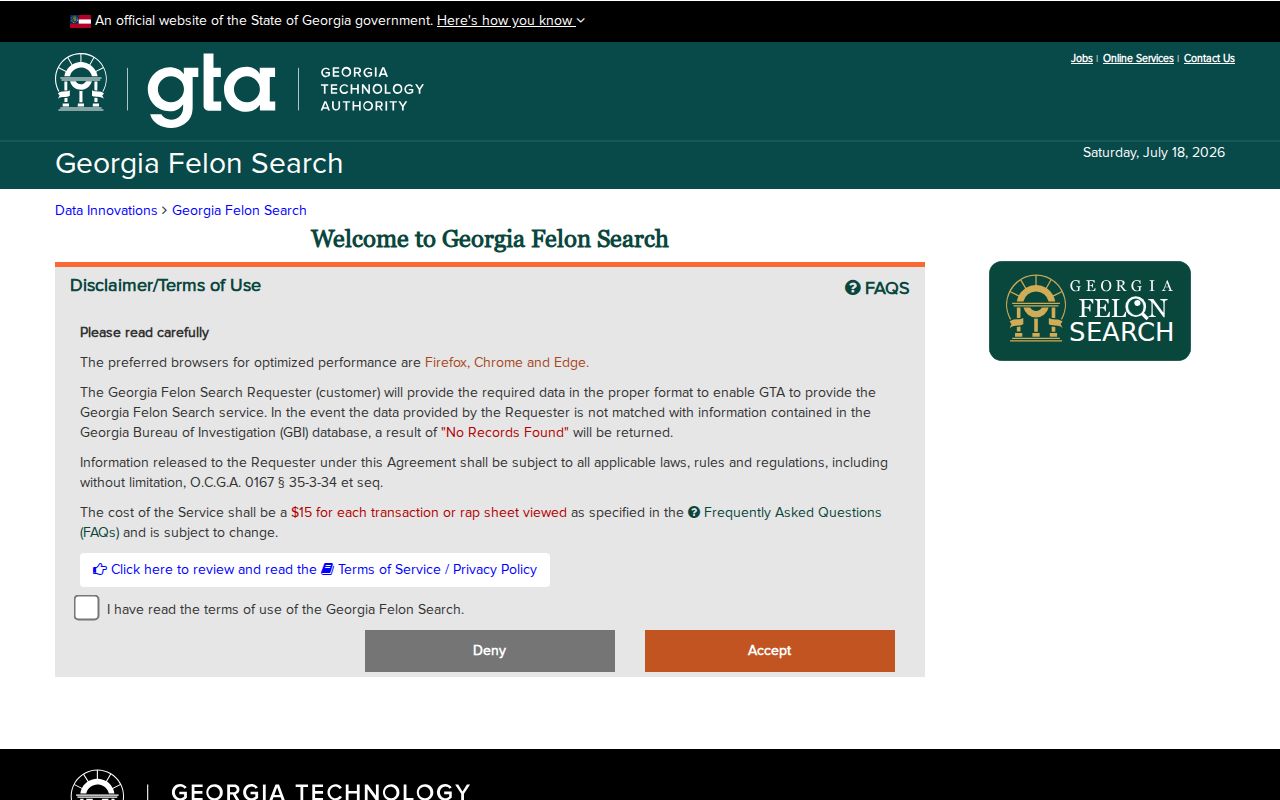
Georgia Felon Search is Georgia's public self-service name search for possible felony-conviction matches. It asks for first name, last name, date of birth, and sex. The price is $15 per search, including a no-record result. When several possible matches appear, opening each selected record costs another $15. It excludes misdemeanors, juvenile felony history, and restricted or sealed information. A name match is not fingerprint confirmation.
The official interface illustrates the narrow scope of this statewide product. See the Georgia Felon Search interface before entering identifying details.
For personal review, GCIC offers appointment or mail procedures, and local law enforcement may provide a copy under local rules. Fingerprint capture for an authorized Georgia program runs through GAPS with IDEMIA/IdentoGO. That channel sends results to the authorized agency and is not an open public search.
| Official channel | Published cost |
|---|---|
| Georgia Felon Search | $15 per search; $15 per selected possible match |
| High-volume billing setup | $100 account fee |
| DCSO records request | Actual allowed costs; first 15 staff minutes free |
| GAPS or personal GCIC inspection | Program or agency specific; confirm before service |
Dawson Sheriff's Records Hub
The DCSO Records and Reports page is the main fallback when no live history or warrant database answers the question. Its written request can seek 911 records, arrest reports, incident reports, and accident reports. The online form requires requester identity and contact details, an address, a description of the requested material, and the name of a victim or suspect. Incident time, location, and case number help narrow the work.
| Form field | How it helps | Status |
|---|---|---|
| Requester name, email, phone, address | Allows response and cost notice | Required |
| Specific record description | Defines the search scope | Required |
| Victim or suspect name | Identifies the event subject | Required by portal |
| Date, time, location, case number | Separates similar incidents | Useful when known |
Records Manager Amanda Martin also accepts the form at agmartin@dawsoncountysheriff.org, by fax at 706-344-3550, by mail, or at the counter. DCSO states that it makes every effort to complete requests within three business days, excluding holidays. Large requests, redaction review, and exemptions can take longer. Charges are given before processing.
Types of Criminal Records
Dawson County criminal records are created at different points in the justice process. Selecting the right type prevents a common error: treating an arrest allegation as the final result.
- Incident and arrest reports describe the event and officer action; request them from the creating agency.
- Booking records document intake, custody, initial charges, bond, and release or transfer data.
- Court files show accusations or indictments, motions, hearings, pleas, dispositions, and sentences.
- GCIC histories connect reported fingerprint-supported arrest cycles with state-reported outcomes.
- Warrant, supervision, and registry records serve distinct court, custody, probation, parole, or public-safety functions.
Dawson County has no separate county State Court listed. Felony matters belong in Superior Court, while Magistrate, Probate, and Dawsonville Municipal Court may hold limited-jurisdiction records. Follow the court named on the citation, warrant, or release paper.
Dawson County's Two Records Campuses
Most court offices are at 25 Justice Way, but sheriff records remain at 19 Tucker Avenue. The address difference matters. A visitor seeking a certified felony disposition should not stand at the detention counter, and a request for a deputy's incident narrative does not belong with the court clerk.
Superior Court Clerk
25 Justice Way, Suite 1302
Dawsonville, GA 30534
706-344-3510
Monday-Friday, 8 a.m.-5 p.m.
Sheriff Records and Reports
19 Tucker Avenue
Dawsonville, GA 30534
706-344-3535 ext. 10171
Monday-Friday, 8 a.m.-5 p.m.
Magistrate Court
25 Justice Way, Suite 3201
Dawsonville, GA 30534
706-344-3730
Monday-Friday, 8 a.m.-5 p.m.
The District Attorney, misdemeanor probation office, and Probate Court also occupy Justice Way suites. Each controls its own work. The historic courthouse at 1 Courthouse Square remains the public defender's listed physical address, not the current Superior Court clerk counter.
What a Dawson County Criminal Record Shows
A full personal history may contain identifiers, arrest cycles, charges, dispositions, and supervision data. A public court or booking view may reveal only part of that set. Read the field label and source before drawing a conclusion.
| Name & Identifiers | Legal name, aliases, date of birth, sex, physical descriptors, SID, FBI number, and OTN when collected and releasable. |
|---|---|
| Arrest / Booking Data | Agency, date, incident or booking number, initial charge, fingerprint event, custody, bond, release, or transfer. |
| Charges & Statutes | Alleged offense names and Georgia Code citations, which may change after prosecutor review. |
| Disposition | Dismissal, nolle prosequi, plea, conviction, acquittal, or other final action. |
| Sentence | Custody, probation, fines, conditions, or First Offender treatment where shown. |
| Custody / Supervision | County jail, GDC custody, misdemeanor probation, felony supervision, or parole status. |
The GBI criminal-history guidance explains access, correction, and record content.
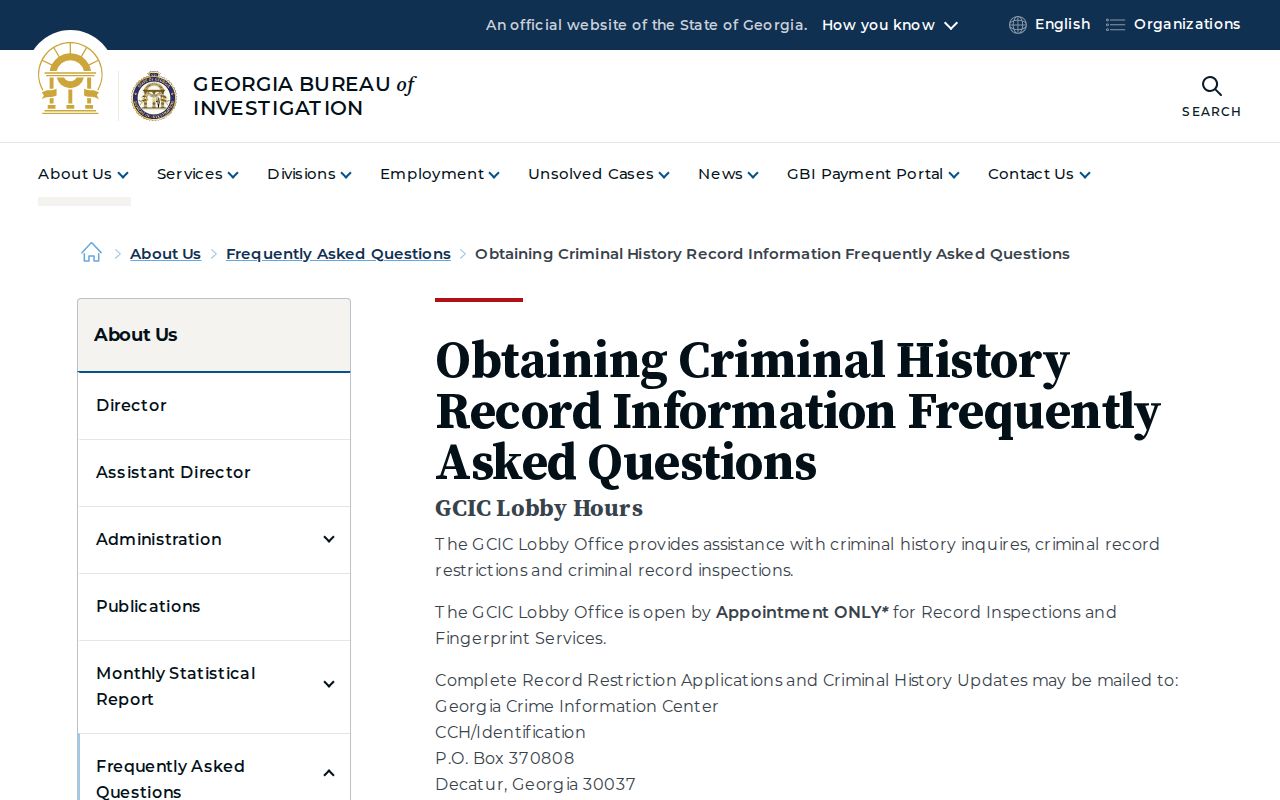
That guidance is especially useful when a court outcome and a statewide cycle do not match. A certified Dawson disposition can support a GCIC correction request.
From Dawson Booking to GCIC
The local-to-state trail follows a sequence: officer report → Tucker Avenue booking → fingerprint and OTN submission → prosecutor filing → court disposition → GCIC update. The OTN links a reported outcome to its arrest cycle. A delay or missing identifier can leave the court file and state history out of sync.
DCSO's detention center is a 192-bed pretrial facility. Its Current Inmates route answers present-custody questions, not historical case outcomes. A released person may vanish from the current list while the incident report, booking file, and court docket remain. A person transferred to state custody belongs in GDC Find an Offender.
- OTN
- Offender Tracking Number used to connect an arrest cycle and its disposition.
- Disposition
- The court's outcome, such as dismissal, plea, acquittal, or conviction.
- Nolle prosequi
- A prosecutor's formal decision not to pursue the charge at that time.
- Rap sheet
- A repository history, not the same thing as one court docket or jail entry.
Public Access Laws
The Georgia Open Records Act generally favors access to public agency records, but it does not erase exemptions for juvenile files, active investigations, protected personal data, security information, or sealed material. GCIC dissemination law separately controls criminal-history products. The source agency must review what can be released.
Key Georgia laws:
O.C.G.A. § 50-18-70 states Georgia's policy favoring access to public records.
O.C.G.A. § 50-18-71 governs inspection, copies, and allowed administrative charges.
O.C.G.A. § 35-3-34 governs criminal-history dissemination and the public felony search.
O.C.G.A. § 35-3-37 provides the main record-restriction and correction framework.
O.C.G.A. § 42-1-12 establishes Georgia's sex offender registration system.
A three-business-day response rule does not always mean the full file arrives in three days. An agency may provide the records, give a production estimate, state lawful costs, or cite the basis for withholding material.
Dawson County Warrant Channels
Dawson County does not advertise one public, name-searchable active-warrant list. DCSO's Most Wanted information is not a complete warrant database. For safe verification, contact the issuing court and then the sheriff's Warrants Services and Transport Unit. Magistrate Court handles arrest and search-warrant process; Superior Court dockets can show bench-warrant events in felony cases; Dawsonville Municipal Court controls city failure-to-appear matters.
Call the sheriff's non-emergency line at 706-344-3636 for routing, not 911. A written DCSO request may seek releasable warrant information, but unserved or sealed material can be withheld. Confirm the case number, issuing court, bond status, and surrender instructions before appearing based on a same-name rumor.
Outstanding warrant: Only the issuing court can recall or quash its warrant. Verify clearance with both the court and serving agency after action is taken.
Sealed, Expunged & Restricted
Georgia uses the term record restriction, formerly called expungement. Restriction limits dissemination of eligible GCIC arrest-history information for noncriminal-justice purposes. It does not mean every police, jail, or court file is physically destroyed. Court sealing is a separate judicial remedy that may accompany restriction. Juvenile confidentiality, First Offender discharge, and conditional discharge follow other rules and should not be treated as synonyms.
For arrests before July 1, 2013, the process can begin with the arresting agency. Later arrests are generally routed through the prosecutor under the current law. The GBI restriction instructions explain eligibility and application paths.
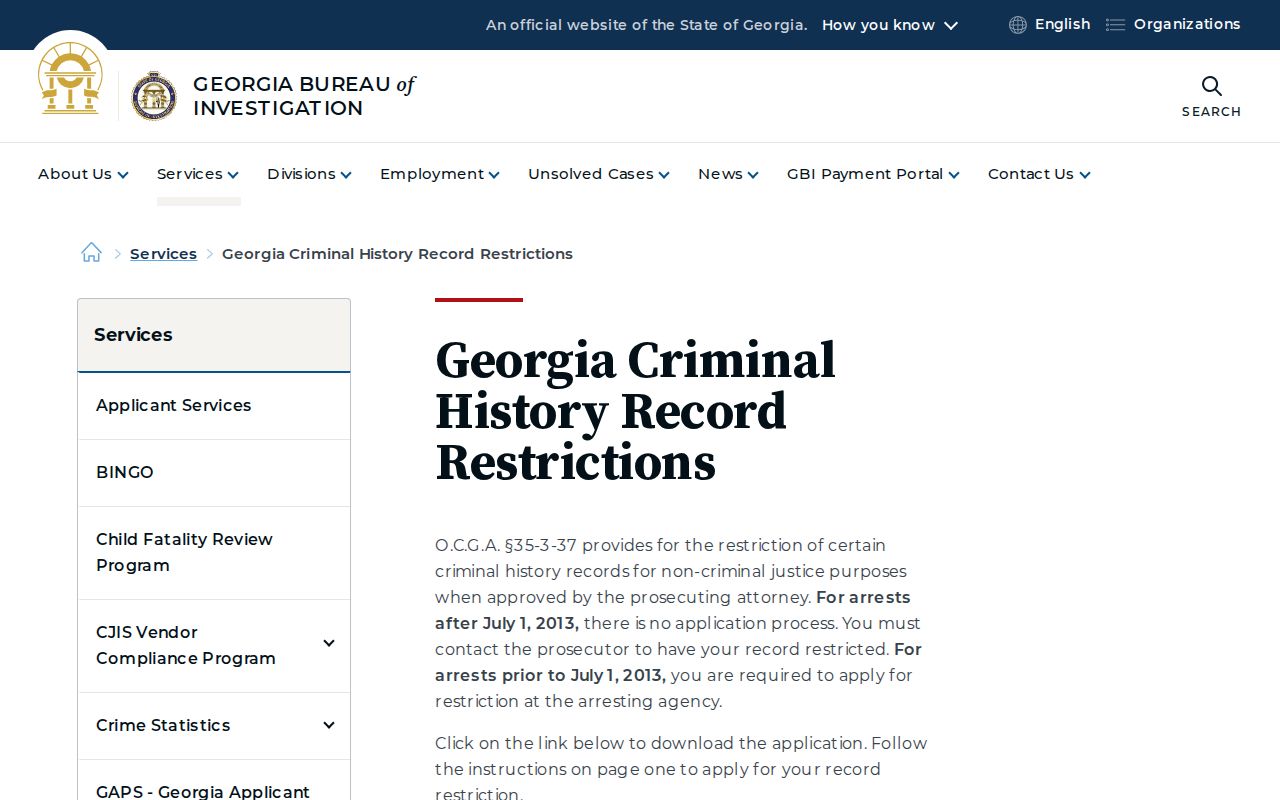
After an order, compare the Dawson County final disposition with the GCIC history. If the outcome is missing, obtain a certified disposition and use the SID or OTN when asking GCIC to correct the cycle.
GCIC's Dawson County Record Role
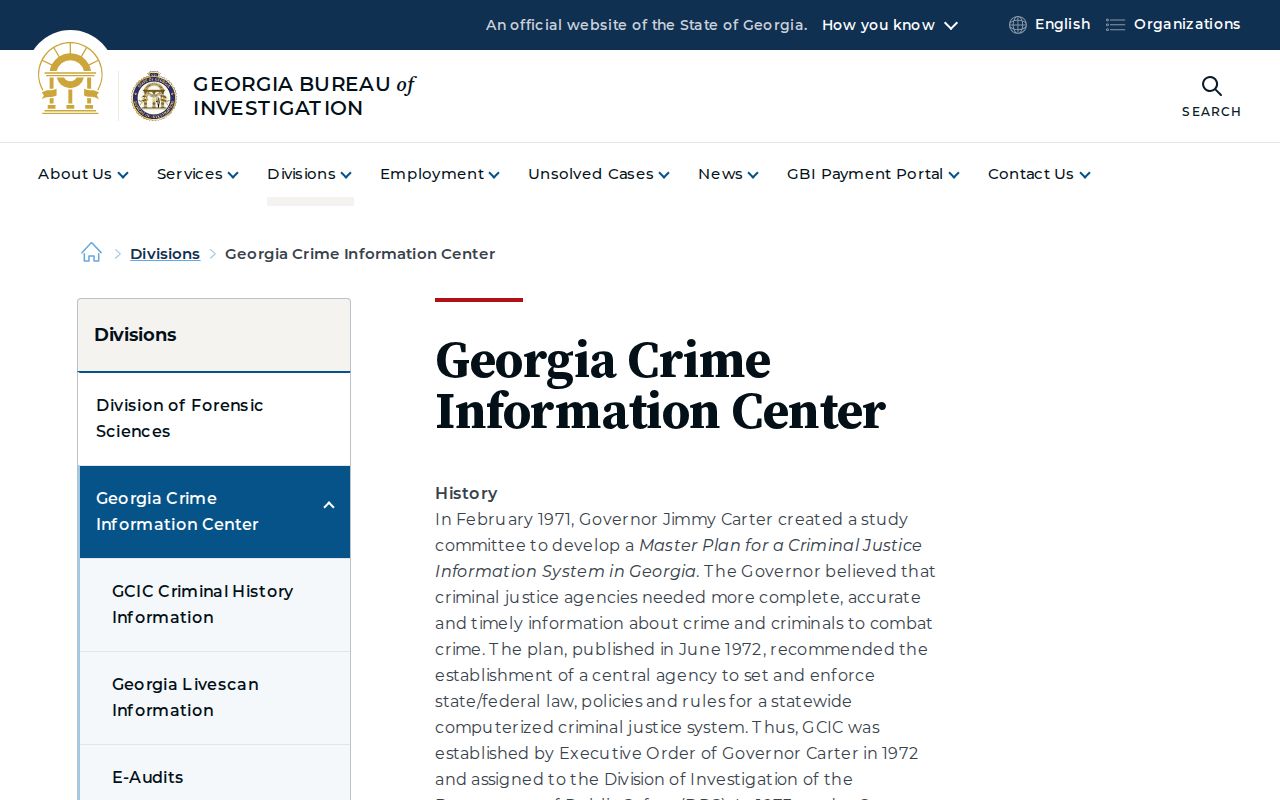
The Georgia Bureau of Investigation operates GCIC, the central Computerized Criminal History repository. It receives fingerprintable arrest information and reported dispositions, assigns or links Georgia State Identification data, and exchanges qualifying information with the FBI. GCIC also supports GAPS and the statewide registry, but those products have different purposes and access rules.
The GCIC program overview shows the repository's range.
A Dawson County court docket and a GCIC history remain separate datasets. Georgia Courts' Criminal Case Data Exchange dashboard measures disposition transmissions and refreshes about every 60 days, which helps explain why a courthouse result can lead a repository update.
When reviewing a personal history, first mark any cycle that lacks an outcome or shows the wrong charge. Ask the Dawson clerk for the final case record and a certified copy if needed. Then send the correction material through GCIC's stated process. An identity dispute may require fingerprints, since a name and birth date cannot prove that two people are the same. Keep copies of the request, court disposition, and repository response so each custodian can see which part of the record needs attention.
Dawson Supervision and Registry Records
Supervision is split. Dawson County misdemeanor probation operates at 25 Justice Way, Suite 2108, while the Georgia Department of Community Supervision's Gainesville Field Office serves Dawson and Hall Counties for adult felony probation and parole supervision. The State Board of Pardons and Paroles makes parole and clemency decisions. A court sentence, supervision record, and GDC custody entry answer different questions.
A probation entry should be read beside the sentencing order. The order states what the judge imposed, while the supervising office tracks compliance and current status. Parole differs because it concerns release from a prison sentence under the State Board's authority. The public parole and pardon status search can supplement GDC results, but neither replaces the Dawson County criminal court file that produced the sentence.
For community safety, the Dawson County Sex Offender Check explains the free Georgia registry and the sheriff's local role. GBI updates the public system from data supplied by sheriffs and other agencies, but it warns that information changes often. A map pin is a reported address, not real-time tracking. Confirm questionable data with DCSO and never use registry information to threaten or harass.
Criminal Records by City in Dawson County
Dawsonville is Dawson County's only incorporated city. The 2020 Census counted 3,720 residents, while a later city figure is an estimate and should not be substituted for that formal count. Official city materials show no independent police department; sheriff-provided police services mean a city-street incident report generally starts with DCSO. City Hall remains the custodian for municipal and administrative records.
The official Census profile confirms the sole-city population context.
A Dawsonville mailing address can fall outside incorporated limits, so use the responding agency and named court rather than the postal city to route a record request.
Dawsonville Criminal History
3,720 residents in the 2020 Census · DCSO supplies police service; City Clerk handles municipal records.