
Arrest History in Dawson County
The Dawson County Sheriff's Office patrols the unincorporated county, serves warrants, and operates the detention system. It also provides police service inside Dawsonville under the city's documented arrangement with the county. Georgia State Patrol may create a separate report for an arrest tied to highway enforcement or a crash. GBI and Georgia Department of Natural Resources officers can create their own agency files as well. The record should be requested from the agency that made the arrest, not merely from the jail that accepted the person.
Once someone reaches the Dawson County detention operation, jail staff create a booking file. Magistrate Court may then hold warrant, first-appearance, and bond material. If a prosecutor files a felony, the Superior Court clerk keeps the later case. Fingerprint-supported data for a qualifying offense can also enter GCIC's Computerized Criminal History repository. These connected records can differ because they capture separate stages. Dawson County arrest history is not one long county-owned report.
Dawson County Booking at Tucker Avenue
After transport to 19 Tucker Avenue, detention staff establish identity, inventory property, take fingerprints and a booking photograph, record the arresting agency and intake charges, conduct medical and security screening, and assign housing. The co-located Dawson County Detention Center has a stated capacity of 192 and primarily holds pretrial detainees. Court-approved work release and supervised work details are among its programs, but the roster's key purpose for a searcher is much narrower: it indicates current Dawson County custody.
The county's official sheriff contact page shows where the agency receives local inquiries.
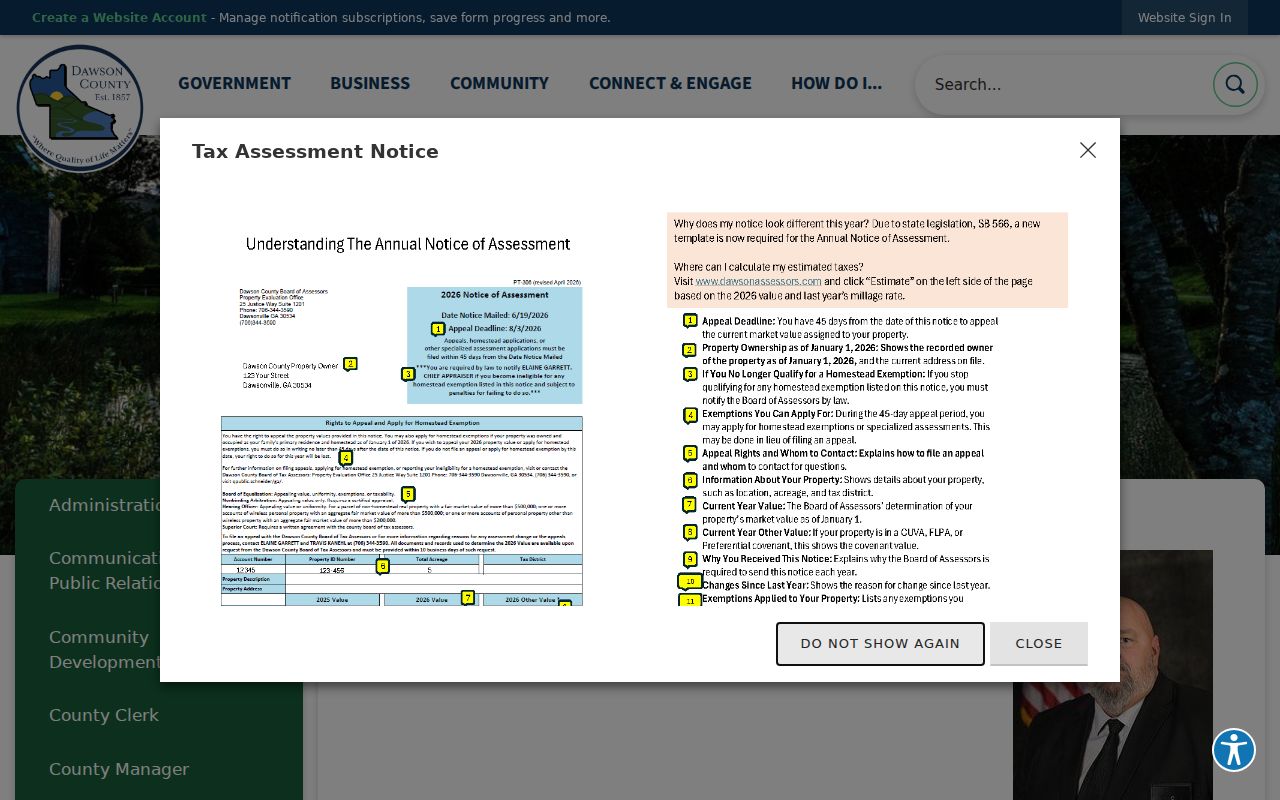
That office location ties the arresting agency's records channel to the detention intake site, but callers should still say whether they need an incident report, booking information, or custody confirmation.
How to Look Up Dawson County Arrests
Use the record's stage to choose a channel. A full name, incident date and time, location, and case number are the best local identifiers. Do not treat a blank current roster result as a clean history.
- Open the DCSO Detention page and choose View Current Inmates for present Dawson County custody.
- If the person is absent or the roster fails, call DCSO at 706-344-3535, visit the lobby, or ask Records and Reports for booking information.
- Request the arrest or incident report from its creator. Use DCSO for sheriff-made reports and Georgia DPS for State Patrol files.
- Check Dawson Superior Court's listed e-access provider or call the clerk at 706-344-3510 for filed felony charges and the final disposition.
- For statewide self-review, follow the Georgia Bureau of Investigation GCIC process. Use GDC Find an Offender after transfer to state prison.
The DCSO written-request form is also the fallback when a current-custody screen supplies too little detail. Records Manager Amanda Martin accepts requests through the online form, by email at agmartin@dawsoncountysheriff.org, fax at 706-344-3550, mail, or the weekday lobby counter. The office states that it makes every effort to complete requests within three business days, excluding holidays. Fees may apply, and the first 15 minutes of qualifying staff time are free under Georgia's open-records fee rule.
Dawson County State Patrol Arrest Files
A State Patrol arrest creates a Georgia DPS record, even if the person is later booked in Dawson County. Ask DPS for the trooper-created incident, citation, crash, photograph, video, or related file. The jail cannot replace that agency narrative. DPS accepts open-records requests through its own unit and form.
The Georgia DPS request page sets out the official route for GSP crash and incident materials.
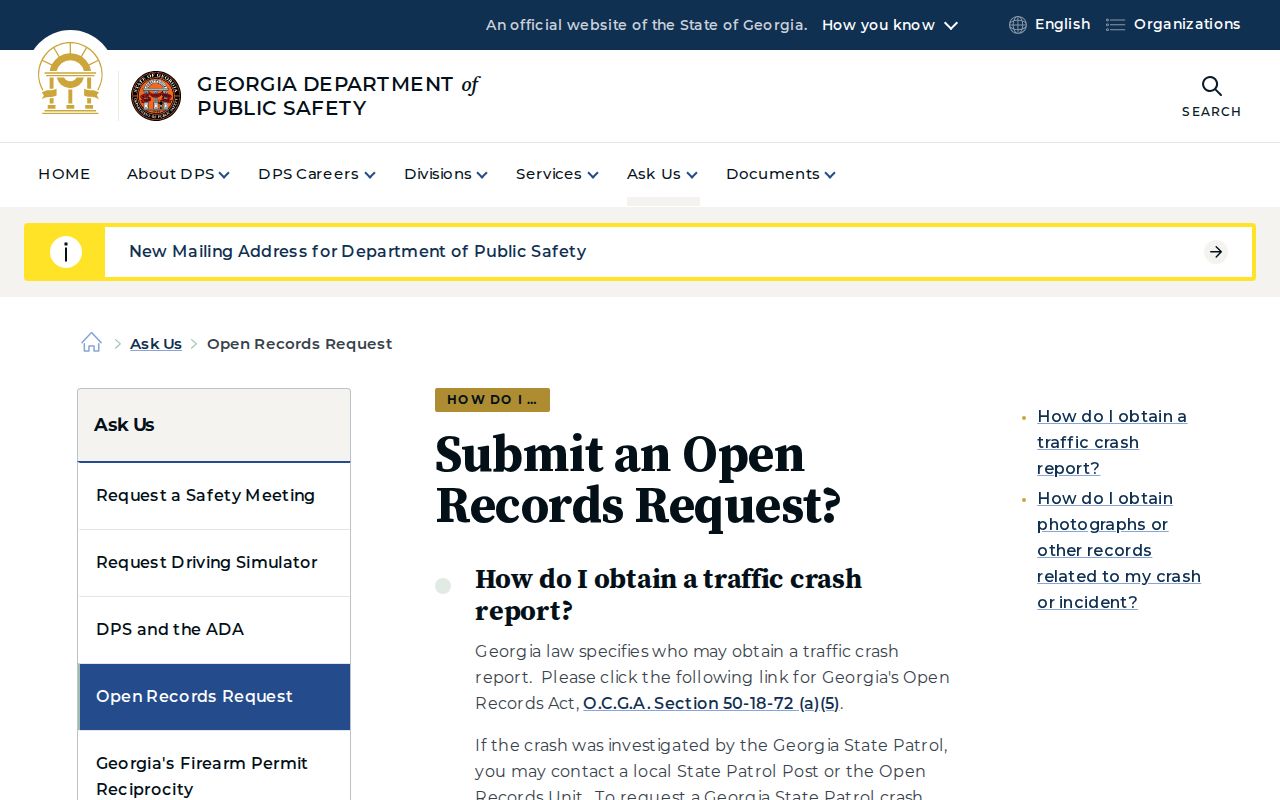
This separate request path matters because Dawson County booking data records intake, while DPS holds what its officer documented in the field.
DPS also publishes prices for distinct record types. Its official open-records fee page lists a $2 incident report and a $5 crash report, along with charges for citations and media.
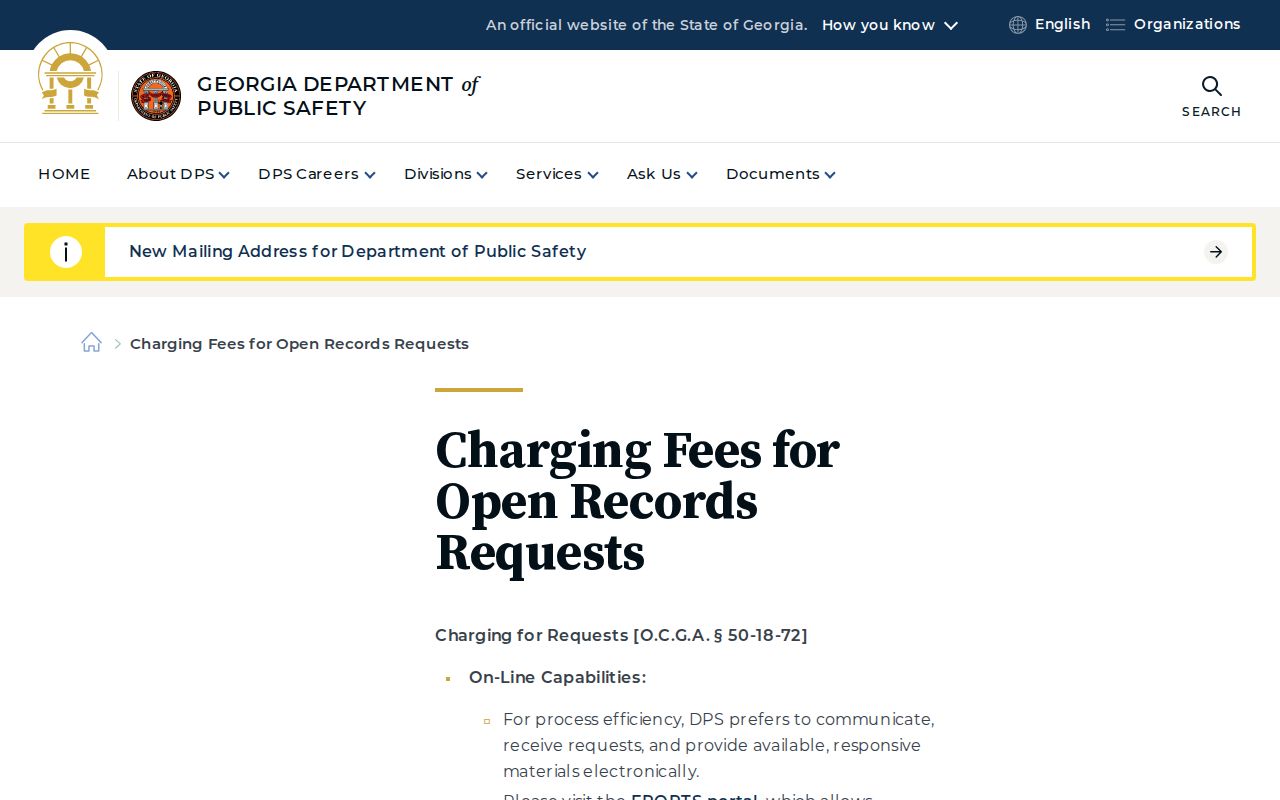
The fee chart helps distinguish a routine report order from a broader request that may require search, review, or media processing.
What an Arrest Record Shows
A request can seek far more than the few facts on a custody screen. Dawson County records may identify the intake event, initial allegations, custody terms, and the link to the next court record. Release depends on redaction rules and the type and status of the file.
| Booking number | The detention system's identifier for the intake event, when releasable. |
|---|---|
| Booking date and time | When Dawson County jail staff processed the person into custody. |
| Arresting agency | The sheriff, State Patrol, or other agency that created the arrest report. |
| Charges | Descriptions and citations alleged at intake, subject to later prosecutor or court changes. |
| Bond | The recorded type and amount, which may change after a judicial decision. |
| Booking photograph | Created during intake; not maintained as a separate historical gallery on the inspected official pages. |
| Release status | Release or transfer information available from custody records, subject to timing and disclosure limits. |
Other requested fields can include the incident number, arrest location, officer, warrant or citation identifier, probable-cause narrative, property inventory, OTN, and linked court case number. Juvenile information, victim identifiers, active-investigation material, and medical or security data can be withheld or redacted.
Three Dawson County Arrest Files
A booking entry, arrest report, and court case answer different questions. The booking entry shows intake and custody. The arresting agency's report records alleged facts and officer action. The court file shows what prosecutors actually filed and what the judge ultimately did. A charge may be amended, dismissed, declined, or resolved under a different label, so the three documents should be compared by incident date, name, case number, and OTN when available.
| File | Custodian | Best use |
|---|---|---|
| Booking entry | DCSO detention operation | Custody, intake charge, bond, release or transfer |
| Arrest report | Arresting agency | Incident facts, probable cause, officer actions and property |
| Court case | Appropriate court clerk | Filed charge, hearings, disposition and sentence |
Dawson County felony case detail belongs with the Superior Court clerk at 25 Justice Way, Suite 1302. Magistrate Court holds early warrant and bond records, while Dawsonville Municipal Court must be checked for qualifying city matters.
Recent Arrests and Booking Logs
DCSO's official website links to Current Inmates from the Detention page. It is a live custody route, not a historical Dawson County arrest log. The static official page did not expose the vendor's form controls or a public sample profile during research. Search fields such as a date-of-birth filter, booking-number control, per-charge bond display, or release date should not be assumed until they appear in the live service.
A person can leave the list after release or transfer while the booking record and court file remain. If the entry is missing, call the jail, ask whether the person was released or transferred, and request the booking record in writing. There is no verified DCSO mobile app or app-only inmate tool. The website, telephone, lobby, and Records and Reports request are the documented options.
After Dawson County Jail Transfer
Once a person moves into Georgia state custody, the county roster is the wrong database. Georgia Department of Corrections Find an Offender covers the state correctional population. GDC itself says results should be verified in writing with Inmate Records and Information at P.O. Box 1529, Forsyth, GA 31029. A missing Dawson County result may therefore reflect transfer, release, a spelling issue, or the fact that the person was never booked locally.
The official GDC offender query is the documented statewide custody fallback.
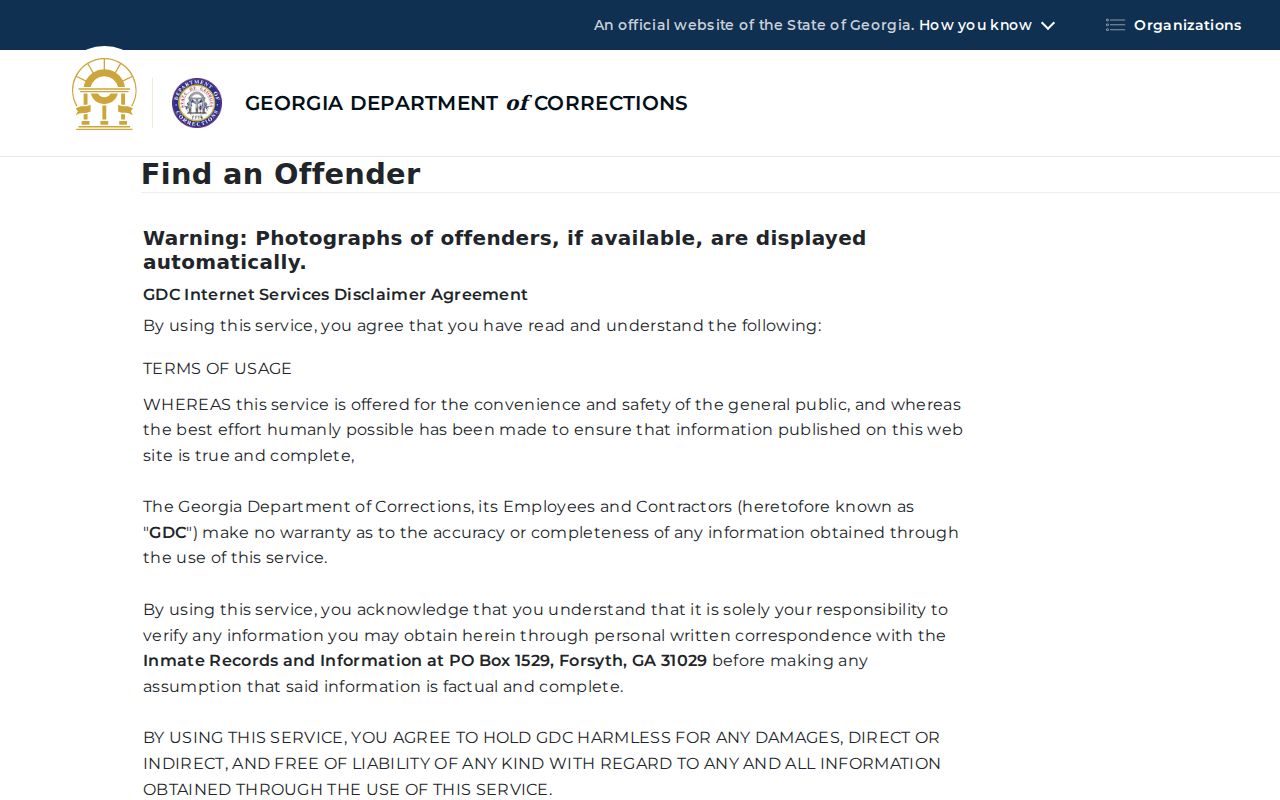
Its sentenced-offender and supervision scope is distinct from the Dawson County jail's current pretrial custody list.
Dawson County Fingerprint Arrest Cycle
For a qualifying fingerprintable offense, the booking agency sends fingerprints and arrest data to the Georgia Crime Information Center. GCIC can assign or associate a Georgia SID, while an Offender Tracking Number links the arrest cycle to a later disposition. The prosecutor and court create their own files, then criminal-justice agencies report the outcome back for matching. That flow explains why a new Dawson County booking may appear locally before a statewide history changes.
It also explains a stale arrest outcome. A person reviewing their own record should compare the GCIC arrest cycle with the certified Dawson County court disposition. GBI accepts correction material supported by arrest identifiers or SID/OTN data and can use fingerprints when identity itself is disputed. Georgia Felon Search is not a substitute: it returns possible Georgia felony-conviction matches and omits misdemeanors, juvenile felony history, and restricted information.
Keep the booking date, arresting agency, charge, OTN, and court case number together when comparing the records. If one layer lacks the final outcome, obtain a certified disposition from the court that handled the charge. That document gives GCIC the strongest basis for matching a dismissal, acquittal, plea, or sentence to the correct Dawson County arrest cycle.
Arrests vs Convictions
The arresting agency and jail document an allegation and custody event. A court creates the conviction record only after a guilty judgment. Dawson County searchers should read the final disposition, since prosecutors may decline or dismiss a charge, a grand jury may return no indictment, or a court may acquit.
| Arrest Record | Conviction Record |
|---|---|
| Created by the arresting agency and booking jail | Created through the court process |
| Shows that arrest and intake occurred | Shows a judgment of guilt |
| Held in agency reports and booking systems | Held by the clerk and reported to GCIC |
| May lead to release, no filing, dismissal, or acquittal | May lead to sentence, appeal, or eligible record relief |
Note: A Dawson County arrest is not proof of guilt, and an intake charge is not the final case outcome.
Georgia calls its qualifying relief process record restriction. It can limit dissemination of eligible GCIC arrest-history information outside criminal justice, but it does not mean every government record is physically destroyed. Court-record sealing is a separate remedy. Start with the court disposition when an old arrest on one's own history lacks its outcome.