
Criminal Cases in the Dawson County Courts
Dawson Superior Court has exclusive authority over felony trials and often hears misdemeanors. Its clerk is the custodian of the filed criminal case. That file is distinct from the sheriff's incident report and jail booking entry. Dawson County belongs to the Northeastern Judicial Circuit, which it shares with Hall County, but a Dawson filing remains with the Dawson clerk. The Superior and Juvenile Courts clerk counter is at 25 Justice Way, Suite 1302, Dawsonville, Georgia 30534. It is open weekdays from 8 a.m. to 5 p.m. The main clerk number is 706-344-3510, and the published criminal-clerk contact is Dianne Avery at 706-344-3500, extension 41318.
Dawson Magistrate Court handles many warrants, first appearances, and preliminary hearings. It does not conduct the final felony trial. Probate Court has a published traffic function, while Dawsonville Municipal Court handles qualifying city matters. Juvenile files are confidential and are not routine public adult dockets. Dawson County does not publish a separate State Court, so the statewide rule that State Courts often hear misdemeanors should not override the county's own court directory.
Dawson County Criminal Court Map
The issuing paper often gives the fastest routing clue. A felony indictment, accusation, judgment, or sentence points to Superior Court. A warrant or preliminary record may still be at Magistrate Court. A traffic citation can belong to Probate Court or Dawsonville Municipal Court, depending on the issuing body and charge. Appeals create a separate appellate docket, but the trial clerk keeps the underlying Dawson County criminal case file.
| Venue | Criminal role | Access point |
|---|---|---|
| Dawson Superior Court | Felony trials, many misdemeanors, final judgment and sentence | Suite 1302; 706-344-3510 |
| Dawson Magistrate Court | Warrants, first appearances, and preliminary hearings | Suite 3201; 706-344-3730 |
| Dawson Probate Court | Published county traffic function | Suite 4332; 706-344-3580 |
| Dawsonville Municipal Court | City ordinance and qualifying local traffic matters | Verify through the City Clerk court channel |
| Georgia appellate courts | Appeals from trial-court judgments | Search each official appellate docket |
The official Magistrate Court page shows the lower-court contact used for warrants and preliminary matters.
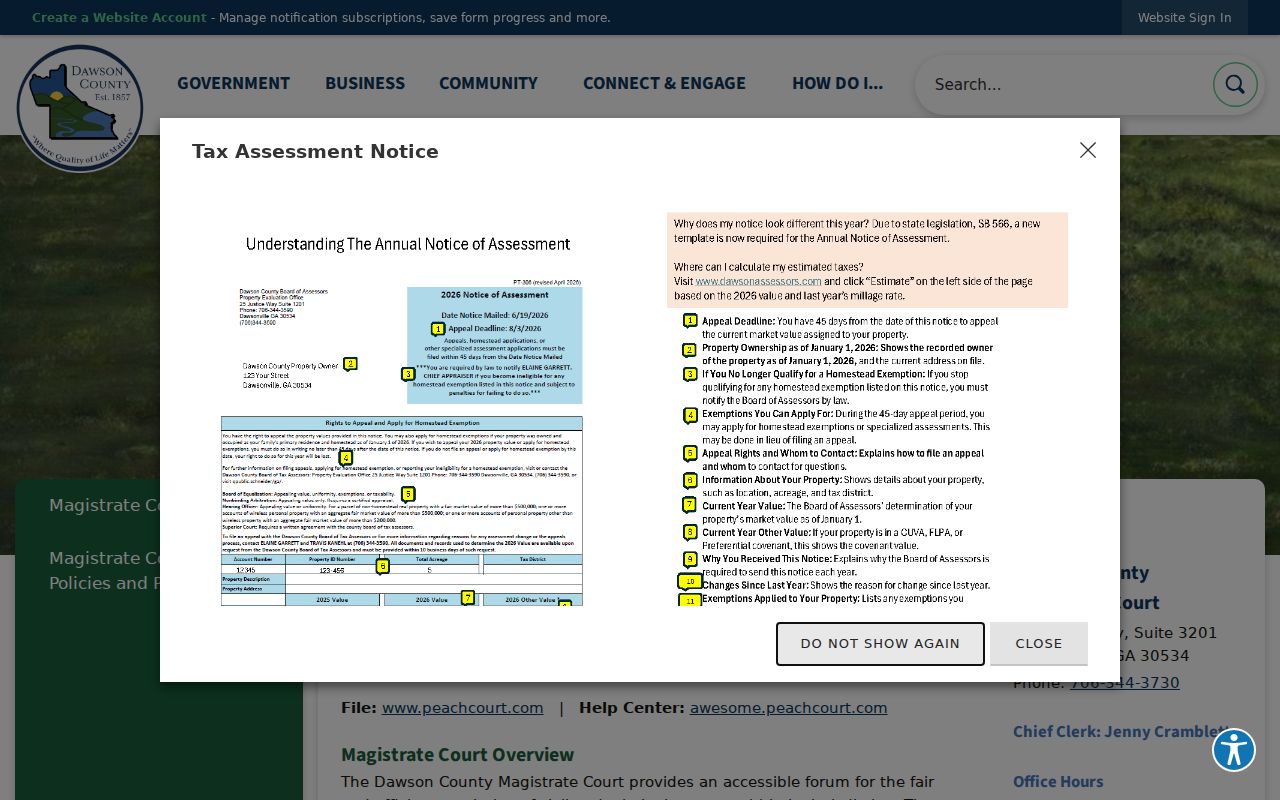
This local listing helps separate the early warrant stage from the Superior Court file that later records a felony disposition.
How to Search Case Records
Georgia has no single free statewide public docket. The Judicial Council's E-Access directory lists participating courts and routes Dawson Superior searches to a provider. The state page warns that an account is required. Because the search controls sit behind that gate, do not assume the provider accepts a date of birth, wildcard, export, or document-image filter. Check the live controls after signing in.
- Identify the venue from the citation, warrant, charge, or prior paperwork.
- Open E-Access, select Dawson Superior, and enter the provider account.
- Use only the fields shown and compare case number, filing date, and charge details.
- Read the result as an index, then note the docket status and disposition.
- Ask the responsible clerk for a certified copy, archived file, or missing order.
| Field or control | Type | Required | Notes |
|---|---|---|---|
| Dawson Superior | Court hyperlink | Yes | Redirects from the state directory to a provider |
| Provider account | Login or registration | Yes | Account requirement is stated by Georgia Courts |
| Provider search fields | Gated controls | Unknown | Confirm current fields, date coverage, and image access after login |
Dawson County Court E-Access Gate
The Judicial Council E-Access directory is a routing tool, not the court record itself. Dawson Superior appears in its participating-court list. An online result can supply a case number and docket clues, but provider coverage, attachments, financial fields, redaction, and per-document costs must be checked inside the account. An absent name is not proof that no Dawson County criminal case exists.
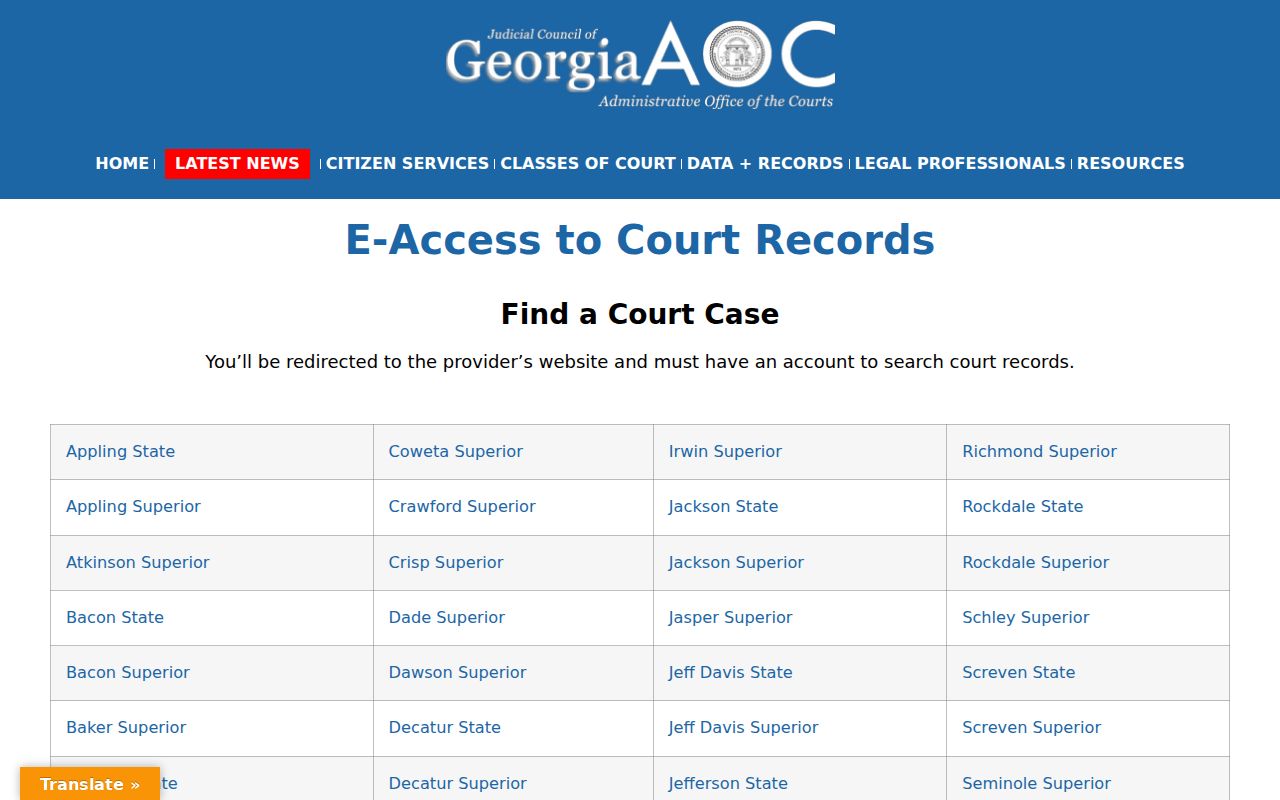
The directory image confirms the official route while also showing why the clerk counter is the sound fallback when the provider cannot supply a filed document.
What the Case File Shows
A Dawson County criminal case file follows the prosecution, not merely the arrest. It can show the charging instrument, court events, lawyer appearances, motions, hearing notices, plea or trial result, judgment, sentence, and later appeal or revocation entries. A booking charge may differ from the accusation or indictment. Read the filed disposition for the outcome of each charge.
| Case Number & Court | Identifies the court file and venue. |
|---|---|
| Charging Document | An accusation, indictment, or other filed charge. |
| Docket Entries | Dated filings, notices, appearances, motions, and orders. |
| Hearing Dates | Scheduled and completed court events shown by the docket. |
| Disposition & Judgment | The result for each charge, such as conviction, dismissal, or acquittal. |
| Sentence & Conditions | Custody, probation, restitution, fines, and other terms in the court order. |
No public, no-login sample Dawson case was available through the official directory during research. Thus, downloadable attachments, birth-date redaction, pagination, and provider fees must be verified after login. The clerk can confirm what the official file contains.
Dawson County Criminal Clerk Counter
Use the clerk when a case is old, an image is missing, or certified proof is needed. Give the full name, case number if known, and an approximate filing year. Ask which documents are public, whether the file is archived, what certification is available, and what copy or delivery cost applies. Research did not locate a current Dawson fee schedule for these requests, so obtain an estimate from the office.
The official Clerk of the Court page confirms the Suite 1302 counter and its weekday hours.
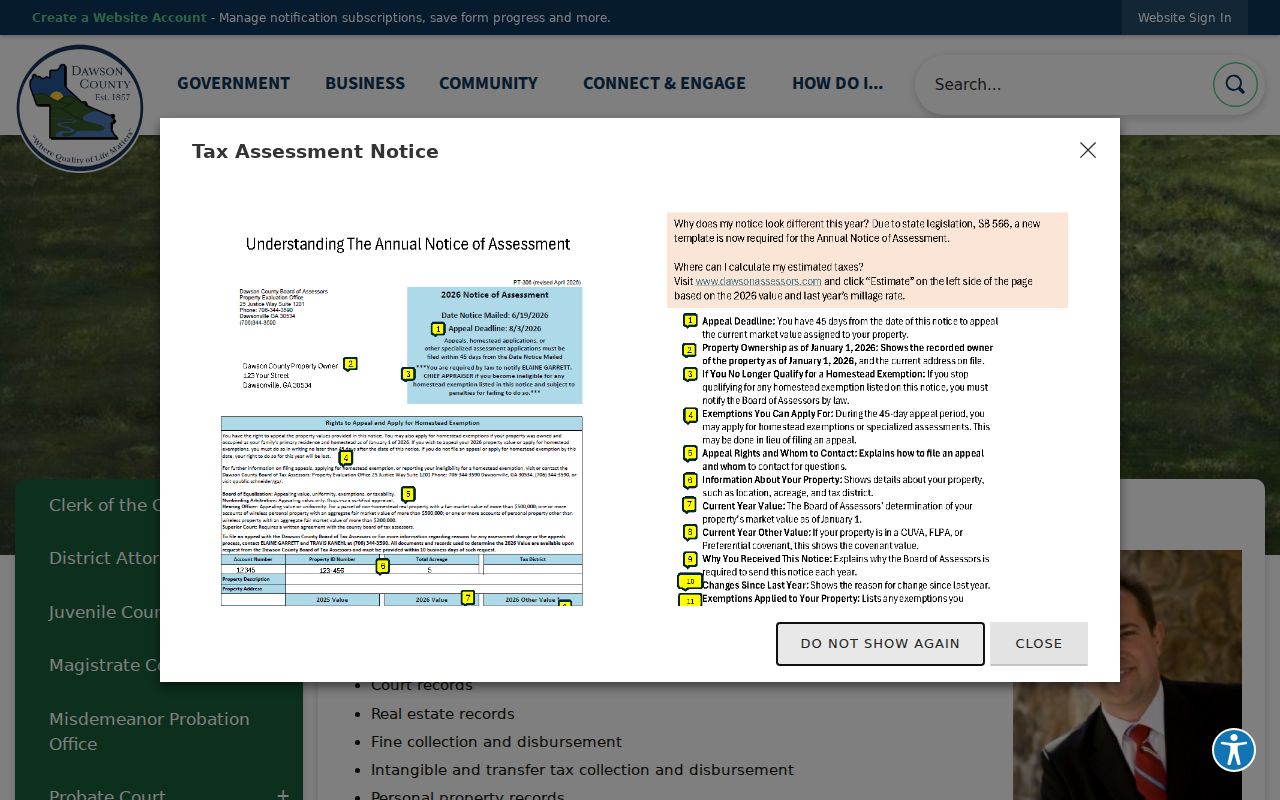
That counter is the authoritative Dawson County route for filed felony pleadings, judgments, sentences, certified dispositions, and older Superior Court material.
Stages of a Criminal Case
A felony can begin with an arrest and a Magistrate Court appearance before it becomes a filed Superior Court prosecution. The District Attorney may present evidence to a grand jury for an indictment or use another proper charging instrument. Arraignment is the hearing where the formal charge is presented and a plea is entered. Motions and hearings follow. The matter may end through a plea, dismissal, acquittal, or trial conviction, and a sentence follows a conviction.
Case flow: Charges Filed › Arraignment › Pretrial › Plea or Trial › Disposition › Sentencing
Timing varies by case. A first-appearance record and a later Superior docket may therefore show different dates and charge wording. For the booking event itself, the separate Dawson County arrest history explains the custody record, while the court file establishes what prosecutors filed and how the judge resolved it.
Read Dawson County Case Outcomes
Docket terms should be read charge by charge. “Convicted” or “guilty” reflects a judgment of guilt. “Dismissed” means a charge ended without conviction. “Nolle prosequi” means the prosecutor formally chose not to continue that charging instrument at that time. “Acquitted” or “not guilty” means the factfinder did not convict. “No bill” means the grand jury did not return an indictment.
- Accusation
- A prosecutor-filed charging document used for misdemeanors and eligible felonies.
- Indictment
- A felony charging document returned by a grand jury as a true bill.
- Dead docket
- A suspended prosecution, not necessarily a final judgment.
- Disposition
- The outcome of a charge or case.
A status of “closed” or “disposed” alone does not state which outcome occurred. Read the judgment, dismissal, plea, or verdict. This is also why a pending charge cannot be described as a conviction.
Access & Restrictions
The Georgia Open Records Act supports access to public agency records, but court files also follow court rules and specific confidentiality laws. Adult filed criminal records are generally available unless restricted, sealed, or protected. Juvenile cases are confidential. Victim and minor identities, security data, and other protected details may be withheld or redacted. Grand-jury deliberations are secret even though a filed indictment can become part of the public case.
Georgia record restriction under O.C.G.A. §35-3-37 limits eligible arrest-history dissemination. Court sealing is a distinct remedy. A restricted GCIC cycle does not always mean every courthouse item vanished, and a sealed court record may not appear online. If the public index omits a known case, ask the Dawson clerk whether it is archived, filed in another venue, restricted, or sealed. Do not ask the clerk to disclose confidential material.
Missing Dawson County Case Disposition
A courthouse docket and a GCIC criminal history are linked but separate. Courts and criminal-justice agencies send final outcomes to GCIC, using an Offender Tracking Number to match the disposition to the fingerprinted arrest cycle. Reporting or matching can lag. If your own Georgia history lacks a Dawson County outcome, obtain the certified disposition from the clerk and compare its case number, arrest date, and OTN with the GCIC entry.
Then contact the reporting court or agency and follow GBI's correction process. GCIC accepts a signed explanation with identifying arrest information or SID and OTN, plus a certified disposition. Fingerprints may be required for an identity dispute. This path corrects the state history; it does not change the underlying court judgment.
Keep copies of the certified order and all correspondence. Recheck the state history after the reporting agency completes its work. If the Dawson County court file itself contains an error, ask the clerk which court procedure applies instead of sending a court-record issue only to GCIC.